 Wales · 13th century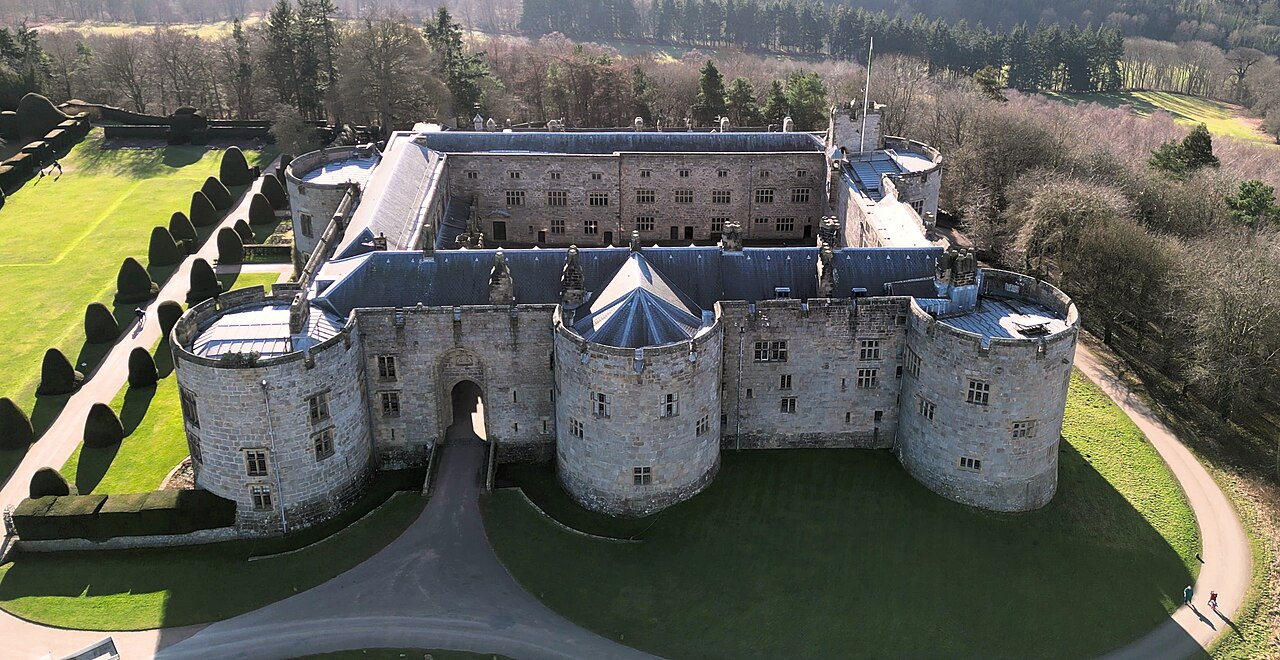
Chirk Castle (Welsh: Castell y Waun) is a Grade I listed castle located in Chirk, Wrexham County Borough, Wales, 1.5 mi (2.4 km) from Chirk railway station, now owned and run by the National Trust.
The castle was built in 1295 by Roger Mortimer de Chirk, uncle of Roger Mortimer, 1st Earl of March as part of Edward I's chain of fortresses across the north of Wales, guarding the entrance to the Ceiriog Valley. It was the administrative centre for the Marcher Lordship of Chirkland. It was run as a March castle by the Layards Edwardes of Chirk until removed by the Star Chamber when it was taken up by the Myddelton family. The Edwardes coat of arms is preserved in the castle. Edwardes became the Barony of Kensington.
The castle was bought by Sir Thomas Myddelton in 1593 for £5,000 (approx. £18 million as of 2024). His son, Thomas Myddelton of Chirk Castle was a Parliamentarian during the English Civil War, but became a Royalist during the 'Cheshire rising' of 1659 led by George Booth, 1st Baron Delamer. Mullioned and transomed windows were inserted in the 16th and 17th centuries; the castle was partly demolished in the English Civil War and then rebuilt. Following the Restoration, his son became Sir Thomas Myddelton, 1st Baronet of Chirke. The castle passed down in the Myddelton family to Charlotte Myddelton (on the death of her father in 1796). Charlotte had married Robert Biddulph, who changed his name to Robert Myddelton-Biddulph, leaving the castle on his death to their son Robert. It then passed down in the Myddelton-Biddulph family.
From before World War I until after World War II the castle was leased by Thomas Scott-Ellis, 8th Baron Howard de Walden, a prominent patron of the arts and champion of Welsh culture. In 1918 Chirk Castle was used as film location for Victory and Peace, directed by Herbert Brenon. The baron opened up parts of the castle to evacuees during the later part of the Second World War. The Myddelton family returned to live at Chirk Castle until 2004. Lieutenant-Colonel Ririd Myddleton was an extra equerry to Queen Elizabeth II from 1952 until his death in 1988.
Chirk remained in the Myddelton family until it was transferred to the National Trust in 1981; the castle and gardens are open to the public.
Text adapted from “Chirk Castle” on Wikipedia, CC BY-SA 4.0.
Chirk Castle ranks #1,229 of 9,079 worldwide in the atlas's castle fame ranking, and #14 of the 107 mapped in Wales. Founded 1295, it is older than 63% of the atlas's dated landmarks — one of 1080 atlas entries founded in the 13th century. Its Wikipedia articles were opened 3,042 times in the last 60 days, more than 78% of the atlas. 6 more atlas landmarks stand within 25 km. The nearest day-trip guide is Wrexham, 14 km away. It is one of the 27 landmarks on the atlas's regional map of North Wales. See how Wales compares in the castle statistics.
View on the interactive castle map →