Castle
Sycharth Castle
WLS Wales
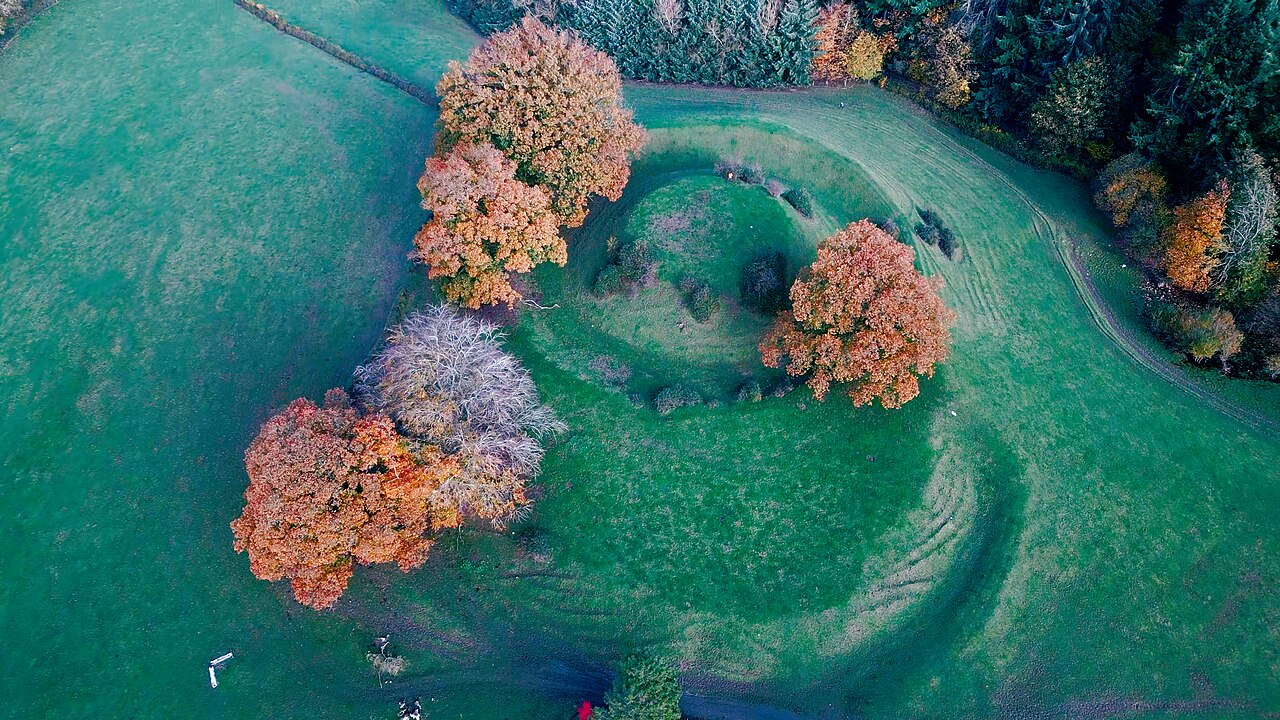
Sycharth was a motte and bailey castle near Llansilin, Powys, Wales. Until 1996 Sycharth was in the historic county of Denbighshire, but was then transferred to the Shire area of Montgomeryshire within Powys. Sycharth was the birthplace of Owain Glyndŵr.
Sycharth sits in the valley of the river Cynllaith, a tributary of the Afon Tanat. The site of Owain Glyndŵr’s manor house lies about a kilometre to the west of the boundary between England and Wales with a belt of woodland on the higher ground to the east known as Parc Sycharth. Immediately to the west of the site is a farm that was the courthouse for the township until the 19th century. The site is on a minor road close to the B4580, south of Llansilin and to the southwest of Oswestry. The site is in the guardianship of Cadw and there is a small carpark with information boards.
The castle was situated in the Welsh territory of Powys Fadog which had formed part of the Welsh Kingdom of Powys. Following the Norman Conquest two of the commotes, Cynllaith and Edeyrnion came under the control of the Normans. There seems little doubt that Sycharth or ‘Cynllaith Owain’ was originally a Motte-and-bailey built by the Normans. An entry in the Domesday Book, would indicate that this had taken place before 1086. The Normans also built a castle at Rhug that would have been the centre for Edeyrnion.
These commotes passed into the possession of Madog Crypl c1275-1304, described as Lord of Glyndyfrdwy and Lord of Cynllaith Owain. Madog was a direct descendant of the Princes of Powys and Gruffudd Fychan II, the father of Owain Glyndŵr, was probably his grandson. Owain Glyndŵr inherited Sycharth in 1369 and it was here that Glyndŵr lived with his wife Margaret Hanmer and their children.
Iolo Goch described Sycharth as containing ‘nine plated buildings on the scale of eighteen mansions, fair wooden buildings on top of a green hill’ and ‘a tiled roof on every house with frowning forehead, and a chimney from which the smoke would grow; nine symmetrical, identical halls, and nine wardrobes by each one’.
Excavations in the early 1960s revealed the presence of two timber halls on the flat topped mound, one being 43 metres in length and provided evidence of the site being burned, as it was by Harry of Monmouth, later to become King Henry V when he was present to oversee the total destruction of the site in May 1403.
Text adapted from “Sycharth” on Wikipedia, CC BY-SA 4.0.
Sycharth Castle ranks #3,698 of 8,134 worldwide in the atlas's castle fame ranking, and #68 of the 100 mapped in Wales. 4 more atlas landmarks stand within 25 km. The nearest day-trip guide is Wrexham, 28 km away. It is one of the 27 landmarks on the atlas's regional map of North Wales. See how Wales compares in the castle statistics.
View on the interactive castle map →Frequently asked questions
Where is Sycharth Castle?
Sycharth Castle stands in Wales, at 52.82485°, -3.18055°.
How famous is Sycharth Castle?
In this atlas's fame ranking: #3,698 of 8,134 worldwide, and #68 in Wales. Fame here combines how many Wikipedia language editions cover a landmark with how many people read them.
What is the nearest castle to Sycharth Castle?
Whittington Castle, about 13 km away.
More castles in Wales
- Blestium Wales · 1st century
- Burry Holms Wales
- Morgraig Castle Wales · 13th century
- Hay Castle Wales · 11th century
More castles
- Tonbridge Castle England · 13th century
- Tykocin Castle Poland · 15th century
- Bewcastle Roman Fort England
- Mamucium England