 England · 16th century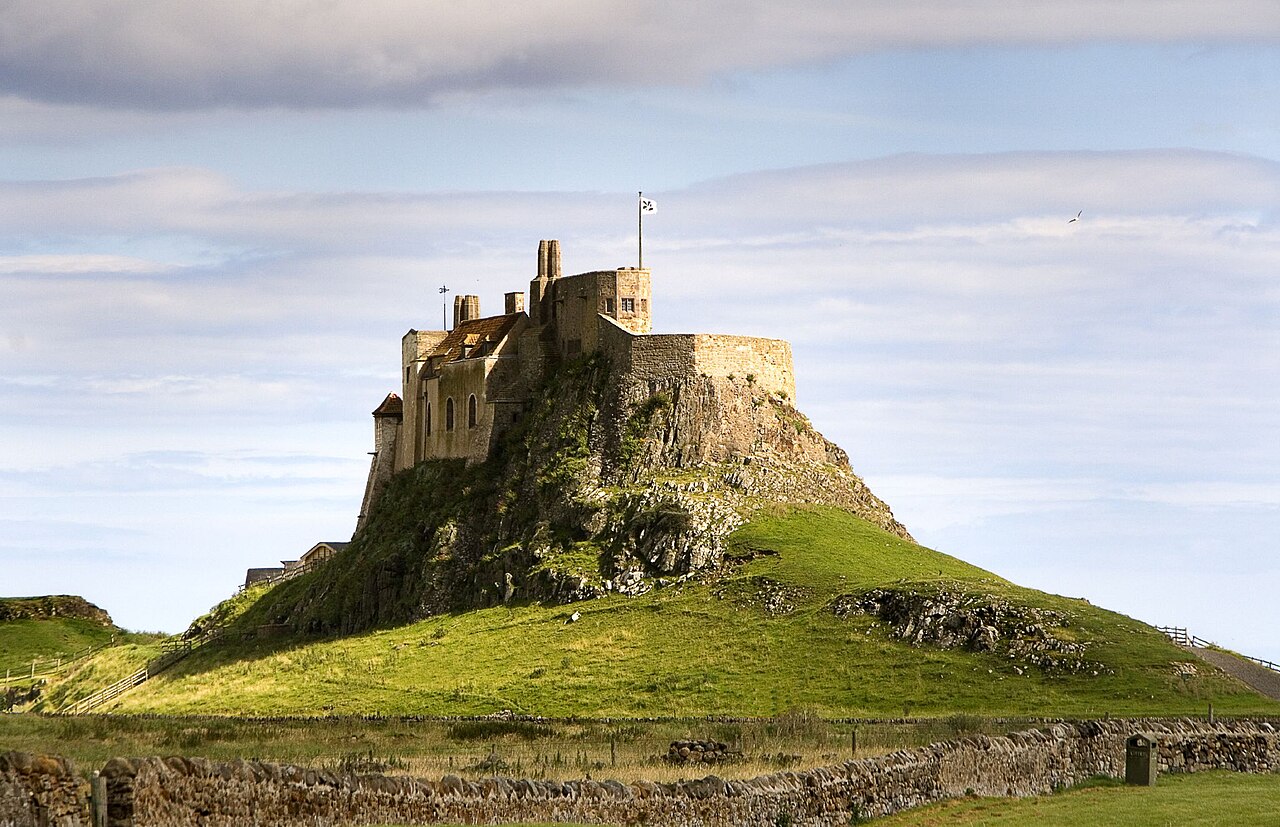
Lindisfarne Castle is a 16th-century castle located on Holy Island, near Berwick-upon-Tweed, Northumberland, England, much altered by Sir Edwin Lutyens in 1901. The island is accessible from the mainland at low tide by means of a causeway.
The castle is located in what was once the very volatile border area between England and Scotland; the area was also frequently attacked by Vikings.
Lindisfarne Priory was finally abandoned for the last time for use as a priory ca. 1537 as part of the dissolution of the monasteries. After Henry VIII suppressed the priory, his troops used the remains as a naval store. In 1542 Henry VIII ordered Thomas Manners, 1st Earl of Rutland to fortify the site against possible Scottish invasion. By December 1547, Ralph Cleisbye, Captain of the fort, had guns that included a wheel-mounted demi-culverin, two brass sakers, a falcon, and another fixed demi-culverin.
Taking advantage of the island's strategic location, in 1549, a small fort was built on a high rock known as Beblowe, the highest point of the island, approximately 1 kilometre east of the monastic buildings, and overlooking the harbour. Military engineer Sir Richard Lee saw only a decayed platform and turf rampart when he inspected the area in 1565. In April 1569, Captain William Reed requested funds to complete the walls of the fort. Elizabeth I had work carried out on the fort, strengthening it and providing gun platforms for the new developments in artillery technology. These works in 1570 and 1571 cost £1191. During the construction work, the priory buildings were used as a source of building stone.
When James I came to power in England, he combined the Scottish and English thrones, and the need for the castle declined. At this time the castle was still garrisoned from Berwick and protected the small Lindisfarne Harbour.
In the eighteenth century, the castle was occupied briefly by Jacobite rebels, but was quickly recaptured by soldiers from Berwick who imprisoned the rebels who dug their way out and hid for nine days close to nearby Bamburgh Castle before making good their escape.
In later years the castle was used as a coastguard look-out and became something of a tourist attraction.
In 1901, it became the property of Edward Hudson, a publishing magnate and the owner of Country Life magazine. He had it refurbished in the Arts and Crafts style by Sir Edwin Lutyens.
Text adapted from “Lindisfarne Castle” on Wikipedia, CC BY-SA 4.0.
Lindisfarne Castle ranks #742 of 9,079 worldwide in the atlas's castle fame ranking, and #55 of the 360 mapped in England. Founded 1550, it is older than 37% of the atlas's dated landmarks — one of 891 atlas entries founded in the 16th century. Its Wikipedia articles were opened 9,821 times in the last 60 days, more than 93% of the atlas. 8 more atlas landmarks stand within 25 km. The nearest day-trip guide is Newcastle upon Tyne, 78 km away. It is one of the 19 landmarks on the atlas's regional map of Northumberland. It is stop 16 of 18 on the Northumberland castle coast, Newcastle upon Tyne to Berwick-upon-Tweed. See how England compares in the castle statistics.
View on the interactive castle map →