 Scotland · 13th century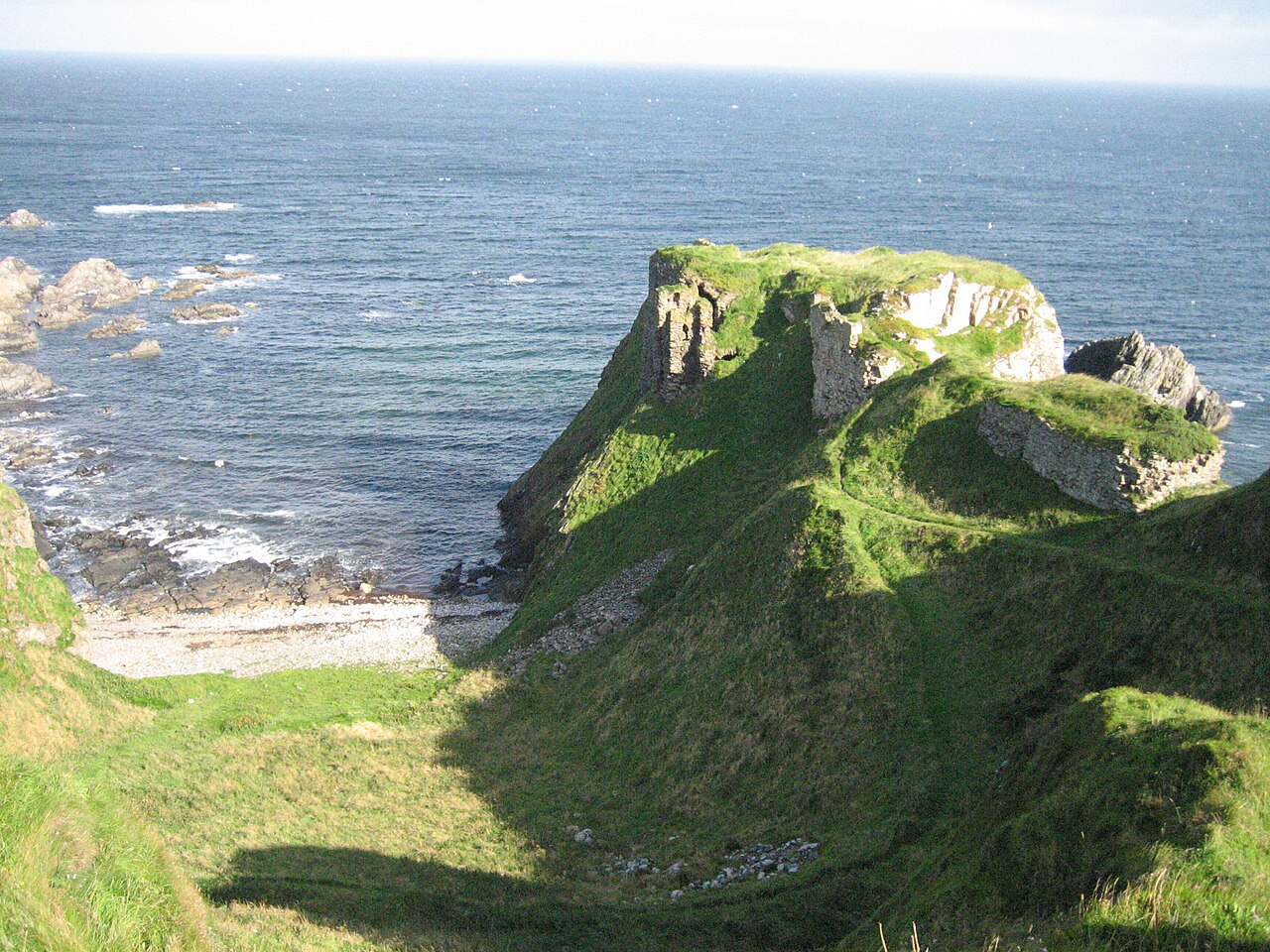
Findlater Castle is the old seat of the Earls of Findlater and Seafield, sitting on a 50-foot (15 m)-high cliff overlooking the Moray Firth on the coast of Banff and Buchan, Aberdeenshire, Scotland.
It lies about 15 km (9.3 mi) west of Banff, near the village of Sandend, between Cullen and Portsoy. The cliffs here contain quartz; the name "Findlater" is derived from the Scots Gaelic words fionn ("white") and leitir ("cliff or steep slope").
The first historical reference to the castle is from 1246. King Alexander III of Scotland repaired this castle in the 1260s in preparation for an invasion by King Haakon IV of Norway. The Norwegians took and held the castle for some time. The castle remains that are still there are from the 14th-century rebuilding, when the castle was redesigned based on the Roslyn Castle model. Walter Ogilvy obtained a licence to repair and rebuild the castle from James II of Scotland in February 1445.
James V of Scotland visited Findlater in November 1535 after a pilgrimage to Tain. James Ogilvy, Laird of Findlater, was Master of Household to Mary of Guise and Mary, Queen of Scots. He lost his inheritance to John Gordon, a son of the Earl of Huntly, after making a plan to imprison his father in a cellar to deprive him of sleep and drive him insane to obtain his lands. After his father's death his mother married John Gordon, who then took possession of the castle and lands, and promptly imprisoned her.
John Gordon fought with James Ogilvy and Lord Ogilvy in July 1562 and injured Lord Ogilvie's arm. Gordon was imprisoned in Edinburgh until his victim healed, according to custom. In September 1562, Mary, Queen of Scots sent an army equipped with artillery from Dunbar Castle to besiege Findlater, and eject John Gordon. When Mary was nearby on 20 September, she had sent her trumpeter messenger to deliver the castle to the captain of her guard, but he was refused. In October 1562, the Earl of Huntly sent Mary the keys of Findlater and Auchindoun, but she was suspicious of the low status of the messenger. Huntly was defeated at the battle of Corrichie and John Gordon was executed.
James Ogilvy, 1st Earl of Findlater, was given the earldom in 1638. He built the nearby Cullen House to take the place of the castle as the family seat and by the time he died in 1653 it was little used and in decline.
Text adapted from “Findlater Castle” on Wikipedia, CC BY-SA 4.0.
Findlater Castle ranks #1,256 of 9,079 worldwide in the atlas's castle fame ranking, and #42 of the 226 mapped in Scotland. Founded c. 1250, it is older than 67% of the atlas's dated landmarks — one of 1080 atlas entries founded in the 13th century. Its Wikipedia articles were opened 19,735 times in the last 60 days, more than 97% of the atlas. The nearest day-trip guide is Aberdeen, 72 km away. It is stop 16 of 23 on the Aberdeenshire castle trail, Stonehaven to Aberdeen. See how Scotland compares in the castle statistics.
View on the interactive castle map →