 England · 12th century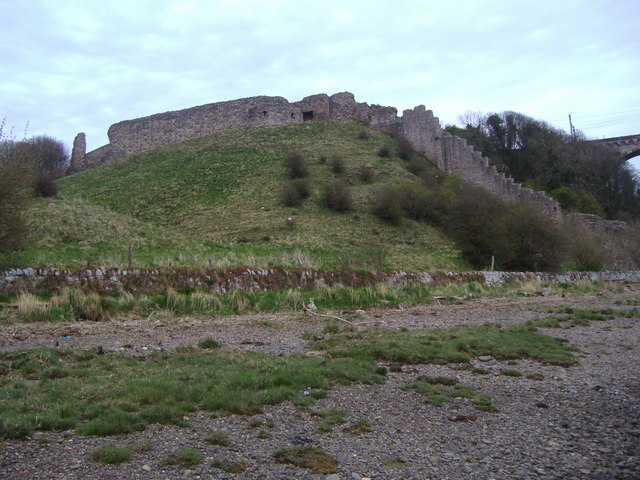
Berwick Castle is a ruined castle in Berwick-upon-Tweed, Northumberland, England.
The castle was commissioned by King David I of Scotland in the 1120s. It was taken by the English forces under the terms of the Treaty of Falaise in 1175 but then sold back to Scotland by King Richard I of England to fund the Third Crusade in around 1190.
In November 1292, representatives of King Edward I of England arrived in Berwick and announced, in the great hall of the castle, King Edward's adjudication in favour of John Balliol of the dispute between him, Robert the Bruce and the count of Holland for the Crown of Scotland. The castle was retaken by the forces of King Edward I in March 1296 during the First War of Scottish Independence. However, the forces of Robert the Bruce recovered the castle for Scotland in April 1318.
In 1330, "Roberto de Lawedre" of the Bass, described as Custodian or Keeper of the Marches and the Castle of Berwick, received, apparently upon the termination of his employment there, £33.6s.8d, plus a similar amount, from the Scottish Exchequer.
Robert Ogle was captain of the castle in 1435. The castle was worth circa £194 in peacetime, with another £200 to be paid in time of war.
In 1464, the Exchequer Rolls of Scotland record that Robert Lauder of Edrington was paid £20 for repairs made to Berwick Castle. The castle finally fell into English hands in the last week of August 1482, when Richard, Duke of Gloucester captured the castle from Patrick Hepburn, 1st Lord Hailes, during his invasion of Scotland. Planned repairs to the castle in 1483 were entrusted to Alexander Lee, a royal chaplain. The master carpenter of Berwick, George Porter, was ordered to build 120 houses in the town, and chambers, a hall, and a lodging in the castle.
The castle was rendered obsolete by the construction of modern ramparts around Berwick during the reign of Elizabeth I in the late 16th century and it went into steady decline. In August 1590, John Selby reported that a round tower used as the castle's only gun emplacement had collapsed in wet weather. The cost of repair in 1597 was estimated at £200, and John Carey wrote that work was necessary because the gap was wide open to Scotland.
Peregrine Bertie, 13th Baron Willoughby de Eresby, Governor of Berwick, wrote that the castle was "scarcely defended with so good a wall as an ancient monastery's orchard".
Text adapted from “Berwick Castle” on Wikipedia, CC BY-SA 4.0.
Berwick Castle ranks #1,857 of 9,079 worldwide in the atlas's castle fame ranking, and #117 of the 360 mapped in England. Founded c. 1125, it is older than 84% of the atlas's dated landmarks — one of 756 atlas entries founded in the 12th century. Its Wikipedia articles were opened 2,000 times in the last 60 days, more than 69% of the atlas. 8 more atlas landmarks stand within 25 km. The nearest day-trip guide is Edinburgh, 76 km away. It is one of the 19 landmarks on the atlas's regional map of Northumberland. It is stop 17 of 18 on the Northumberland castle coast, Newcastle upon Tyne to Berwick-upon-Tweed. See how England compares in the castle statistics.
View on the interactive castle map →