 England · 12th century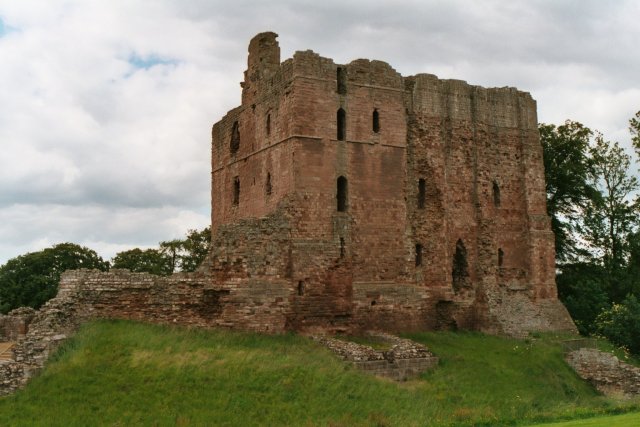
Norham Castle (sometimes Nornam) is a castle in Norham, Northumberland, England, overlooking the River Tweed, on the border between England and Scotland. It is a Grade I listed building and a Scheduled Ancient Monument. The castle saw much action during the wars between England and Scotland.
The castle was founded when Ranulf Flambard, Bishop of Durham from 1099 to 1128, gave orders for its construction in 1121 to protect the property of the bishopric in north Northumberland from incursions by the Scots.
In 1136, David I of Scotland invaded Northumberland and captured the castle. It was soon handed back to the bishopric but was captured again in 1138 during another invasion. This time, the castle's structure was substantially damaged. It remained derelict until Hugh de Puiset, Bishop of Durham from 1153 to 1195, had the castle rebuilt. The work was probably directed by Richard of Wolviston, who was the bishop's architect.
In 1174, Hugh de Puiset supported the rebels in a revolt against Henry II, during which the Scottish king, William the Lion, invaded Northumberland. The rebels were defeated, and as a result, Bishop Hugh was forced to relinquish Norham Castle to the crown. The castle was administered by a constable appointed by the crown and garrisoned by royal soldiers. This continued until 1197, two years after Hugh's death, when it was restored to his successor, Philip of Poitou. The latter showed himself to be loyal to King John. When Philip died in 1208, the castle reverted to royal control.
In 1209, the castle accommodated both King John and William the Lion on an occasion when William did homage for his English lands to the English king. Between 1208 and 1211, King John maintained the castle defences in good order and provided a strong garrison. The strong defences were needed in 1215, when Alexander II of Scotland, son of William the Lion, besieged the castle for forty days without success. In 1217, the castle was once again restored to the bishopric of Durham.
Edward I, known as the Hammer of the Scots, visited the castle more than once. He did so in 1292 when John Balliol, the King of Scotland, did homage to him there. In 1296, Edward invaded Scotland, and during his campaign, his queen, Marguerite of France, remained at Norham Castle.
Text adapted from “Norham Castle” on Wikipedia, CC BY-SA 4.0.
Norham Castle ranks #2,076 of 9,079 worldwide in the atlas's castle fame ranking, and #138 of the 360 mapped in England. Founded 1121, it is older than 84% of the atlas's dated landmarks — one of 756 atlas entries founded in the 12th century. Its Wikipedia articles were opened 1,977 times in the last 60 days, more than 69% of the atlas. 10 more atlas landmarks stand within 25 km. The nearest day-trip guide is Edinburgh, 70 km away. It is one of the 19 landmarks on the atlas's regional map of Northumberland. It is stop 18 of 18 on the Northumberland castle coast, Newcastle upon Tyne to Berwick-upon-Tweed. See how England compares in the castle statistics.
View on the interactive castle map →