 England · 16th century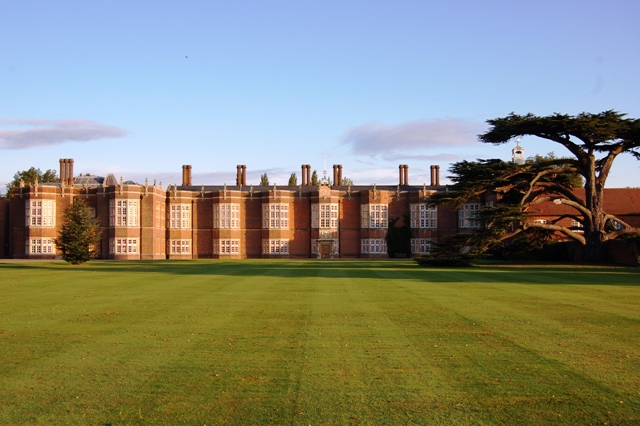
The Palace of Beaulieu ( BEW-lee) or Newhall is a former royal palace in Boreham, Essex, England, north-east of Chelmsford. The surviving part is a Grade I listed building. The property is currently occupied by New Hall School.
The estate on which it was built – the manor of Walhfare in Boreham – was granted to the Canons of Waltham Abbey in 1062. After various changes of possession, it was granted by the Crown to Thomas Butler, 7th Earl of Ormond in 1491. By this time, it had a house called New Hall.
In 1516, New Hall was sold by Thomas Boleyn, father of Anne Boleyn, to King Henry VIII for £1,000. The king rebuilt the house in brick at a cost of £17,000. He gave his new palace the name Beaulieu, meaning "beautiful place" in French. The name expressed Henry's desire for fine things, though the name change did not outlast the century.
A royal wardrobe official, James Chapell, took measurements of the new apartments and travelled to Flanders to buy tapestries. He bought eleven different qualities of material, to cover an area of 3,238 Flemish ells (1,818 square yards). The chronicle writer Edward Hall describes a banquet and masque at "Newhall, otherwyse called Beaulieu" in September 1519. Eight disguised courtiers entered after the feast and danced with the ladies. Catherine of Aragon removed their visors or masks, revealing them to be all men aged over fifty. Another group of six younger men, including four hostages for the French treaty, then came in costume to dance.
On 23 July 1527 Henry's court arrived at Beaulieu on his summer progress, staying, unusually, for over a month in the company of a large number of nobles and their wives, including Anne Boleyn's father who had been created Viscount Rochford, the Dukes of Norfolk and Suffolk, the Marquess of Exeter, the Earls of Oxford, Essex, and Rutland, and Viscount Fitzwalter. It was here that Henry devised a scheme to allow him to cohabit with his intended successor of Queen Catherine of Aragon, Anne Boleyn, by obtaining a Papal bull that declared Henry's marriage to Catherine invalid, effectively allowing him to commit bigamy by claiming he was technically unmarried in the first place. This plan was dropped when Cardinal Wolsey discovered the plan, though Pope Clement VII did, in fact, issue a bull to the same effect that December.
Text adapted from “Palace of Beaulieu” on Wikipedia, CC BY-SA 4.0.
Palace of Beaulieu ranks #1,690 of 9,079 worldwide in the atlas's castle fame ranking, and #108 of the 360 mapped in England. Founded 1516, it is older than 42% of the atlas's dated landmarks — one of 891 atlas entries founded in the 16th century. Its Wikipedia articles were opened 3,759 times in the last 60 days, more than 82% of the atlas. The nearest day-trip guide is Southend-on-Sea, 29 km away. See how England compares in the castle statistics.
View on the interactive castle map →