Fortress
Royal Citadel
ENG England · 16th century
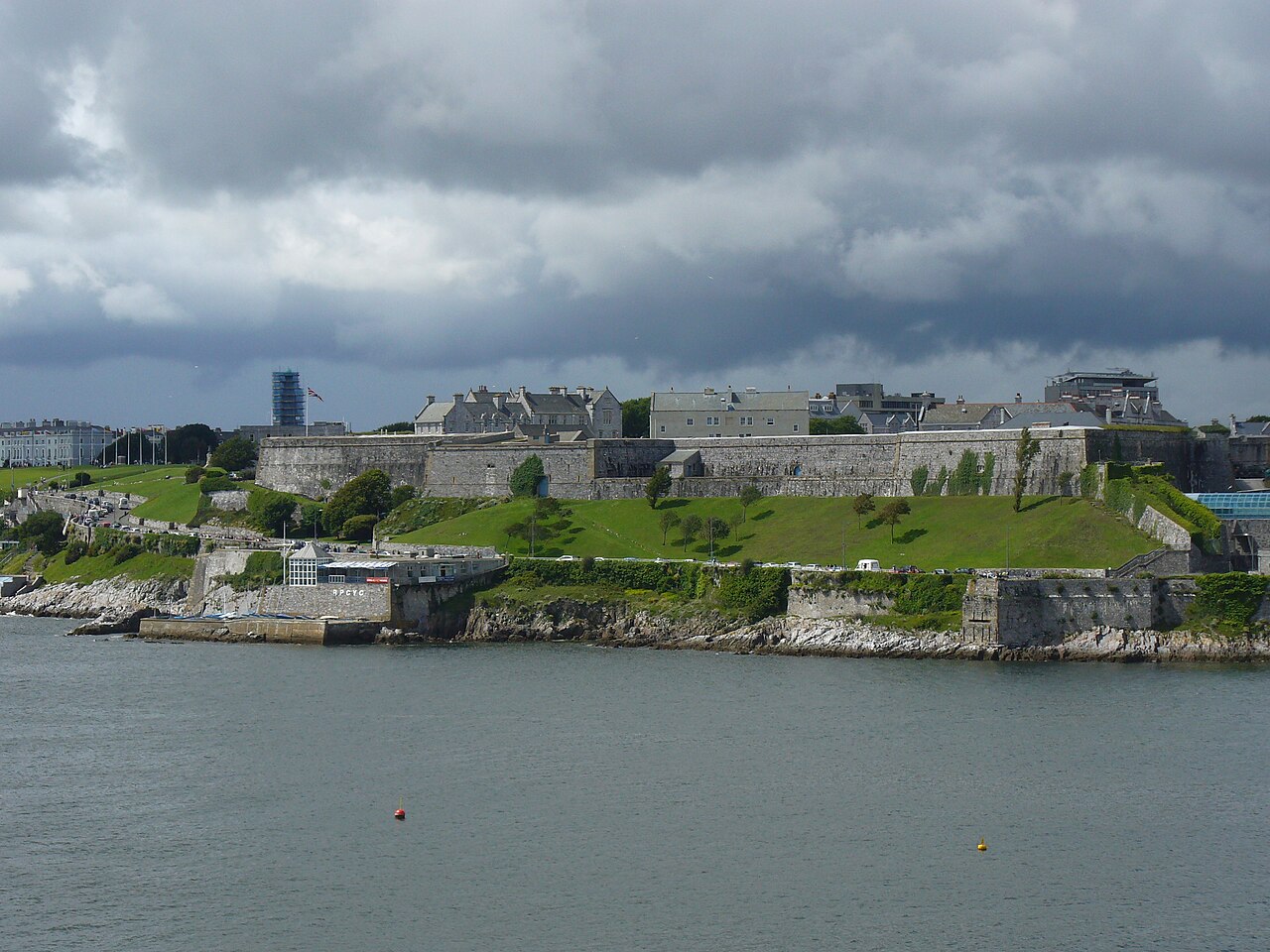
The Royal Citadel in Plymouth, Devon, England, was built in the late 1660s to the design of Sir Bernard de Gomme. It is at the eastern end of Plymouth Hoe overlooking Plymouth Sound, and encompasses the site of the earlier fort that had been built in the time of Sir Francis Drake. The citadel site is a Scheduled Monument and many of the buildings within are Grade II Listed.
In 1590, Sir Francis Drake was appointed to improve the defences of Plymouth. After setting up some temporary artillery batteries, Drake petitioned the Privy Council for the funds to build a fort on Plymouth Hoe that could dominate the Cattewater, the approach to Sutton Harbour, which at that time was the main port at Plymouth. By May 1592, Elizabeth I had decided that the fort could be funded by a tax on every hogshead of pilchards which was exported from Plymouth. Construction of the fort dragged on until 1596 and was only finished after the government had drafted in a further 500 labourers. The northern landward side of the fort was protected by two bastions and it enclosed the previously established batteries overlooking the Cattewater, and also the Fisher's Nose Blockhouse, located on its south east corner, which dates from about 1540. A further blockhouse called Queen Elizabeth's Tower was built a short distance to the west of Fisher's Nose.
During the Dutch Wars of 1664–67 King Charles II decided that it was necessary to realise the importance of Plymouth as a channel port. The original plan was to build a regular self-contained fort with five bastions, to the west of Drake's Fort, but this was revised to take in the earlier fort, resulting in the Citadel's irregular outline. Possibly due to Plymouth's support for the Parliamentarians in the Civil War its guns could also fire on the town. De Gomme faced some criticism over his unorthodox design: for instance when Samuel Pepys visited in 1683 he wrote that "De Gomme hath built very sillily".
Work began in March 1665, but it was not until 18 July 1666 that the foundation stone was laid by John Granville, 1st Earl of Bath. This stone, inscribed 'Jo Earle of Bathe 1666', is still in the wall facing the Hoe. Elements from the earlier Tudor fort were incorporated into the new work. The Citadel is built of local limestone, while the English Baroque gateway, designed by Sir Thomas Fitz, is of Portland stone.
Text adapted from “Royal Citadel, Plymouth” on Wikipedia, CC BY-SA 4.0.
Royal Citadel ranks #5,098 of 8,764 worldwide in the atlas's castle fame ranking, and #316 of the 356 mapped in England. Founded 1592, it is older than 35% of the atlas's dated landmarks — one of 827 atlas entries founded in the 16th century. Its Wikipedia articles were opened 1,541 times in the last 60 days, more than 61% of the atlas. 3 more atlas landmarks stand within 25 km. See how England compares in the castle statistics.
View on the interactive castle map →Frequently asked questions
Where is Royal Citadel?
Royal Citadel stands in England, at 50.3649°, -4.13805°.
When was Royal Citadel built?
The atlas dates its founding to 1592. Earlier structures may have stood on the site; this is the earliest documented founding year.
How famous is Royal Citadel?
In this atlas's fame ranking: #5,098 of 8,764 worldwide, and #316 in England. Fame here combines how many Wikipedia language editions cover a landmark with how many people read them.
What is the nearest castle to Royal Citadel?
Drake's Island, about 2 km away.
More castles in England
- Warblington Castle England
- West Cowes Castle England · 16th century
- Whorlton Castle England · 12th century
- Horse Sand Fort England · 19th century
More fortresses
- El Cañuelo Puerto Rico · 17th century
- Fort Jay United States · 18th century
- Fort de Chartres United States · 18th century
- Fuerte San Miguel Uruguay · 18th century