Ruin
Warblington Castle
ENG England
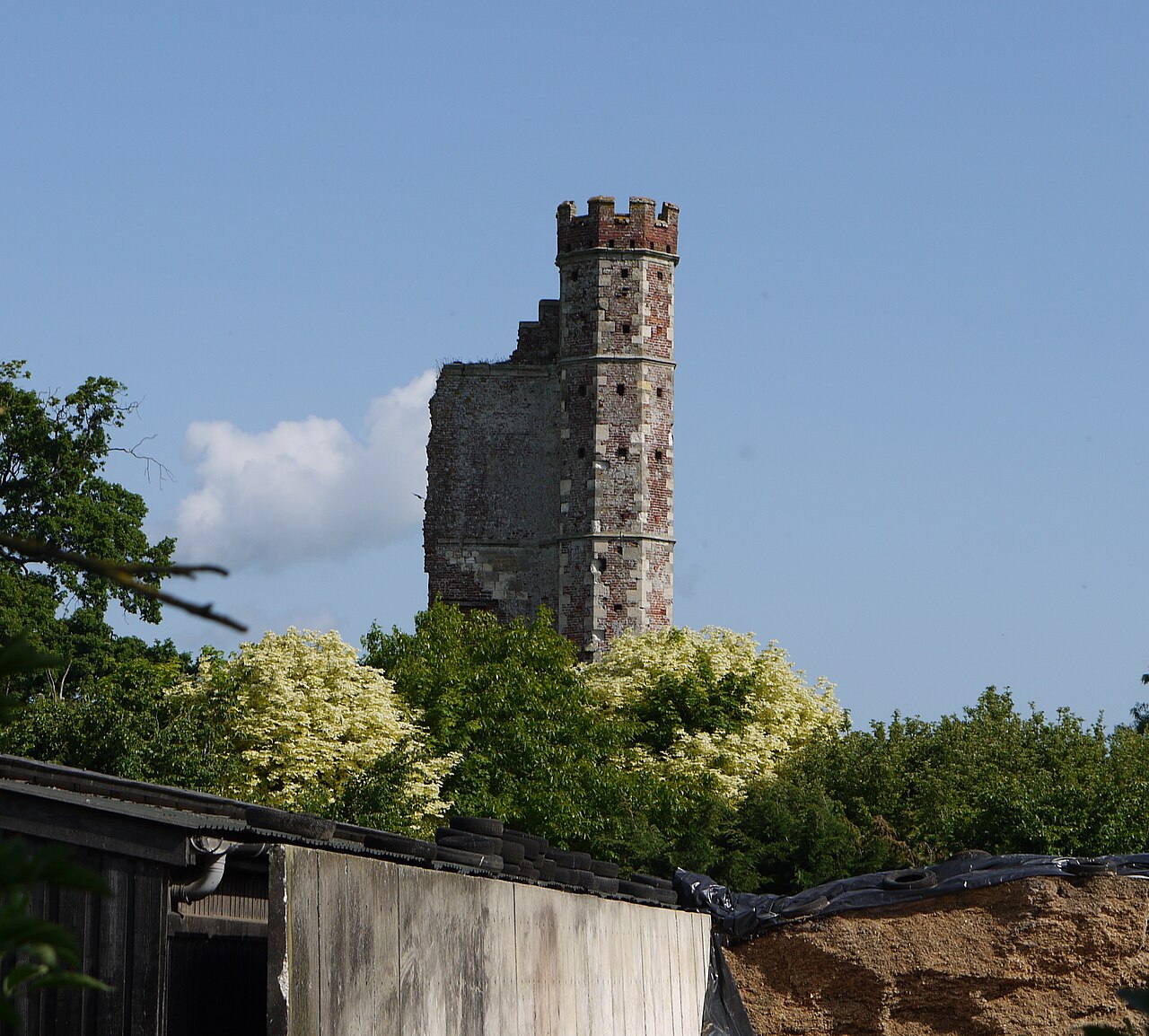
Warblington Castle or Warblington manor was a moated manor near Langstone in Havant parish, Hampshire. Most of the castle was destroyed during the English Civil War, leaving only a single gate tower, part of a wall, and a gateway. The property, now in the village of Warblington, is privately owned and does not allow for public access.
Located near Langstone in Hampshire, a Saxon settlement was established in the 7th century. It is mentioned in the Domesday Book of 1086, indicating a population of about 120.
The owner of the property at the time was Roger, Earl of Shrewsbury; after his death in 1094, it was inherited by his second son, Hugh. The owner in 1186 was William de Courci.
Some sources claim that the manor received a licence to crenellate in 1340 but this is disputed. The manor passed through several hands before coming into the possession of Richard Neville, 16th Earl of Warwick, in the 15th century. The villagers were subsequently removed, the land becoming a private deer park for Neville.
With the execution of Edward Plantagenet, 17th Earl of Warwick, by Henry VII, the manor passed to the crown. In 1513 Henry VIII gave the manor to Margaret Pole, Countess of Salisbury, who had a new moated manor built between 1515 and 1525.
After Margaret Pole was attainted for treason, temporary grants of the manor were made to William FitzWilliam, 1st Earl of Southampton, and Thomas Wriothesley, 1st Earl of Southampton. Henry VIII then granted the manor to Sir Richard Cotton. On 28 October 1551, Mary of Guise, the widow of James V of Scotland, stayed a night in the castle as the guest of Sir Richard Cotton. Edward VI visited the "fair house of Sir Richard Cotton" in August 1552.
Elizabeth I may have visited for two days in 1586. George Cotton of Warblington was a Catholic recusant, visited by priests including Thomas Lister alias Butler in 1603, and in 1613 a reliquary of a martyr Mark Barkworth was found in John Cotton's study. The Cotton family continued to hold the house until the English civil war.
In January 1643 Parliamentarians under Colonel Richard Norton of Southwick Park garrisoned the house with a force of between 40 and 80 men. It was besieged and taken by Ralph Hopton, 1st Baron Hopton, although Colonel Norton managed to escape.
The Cotton family were Royalists, which resulted in the manor being largely demolished by Parliamentarian forces.
Text adapted from “Warblington Castle” on Wikipedia, CC BY-SA 4.0.
Warblington Castle ranks #5,043 of 8,764 worldwide in the atlas's castle fame ranking, and #315 of the 356 mapped in England. Its Wikipedia articles were opened 1,590 times in the last 60 days, more than 62% of the atlas. 8 more atlas landmarks stand within 25 km. The nearest day-trip guide is Portsmouth, 10 km away. See how England compares in the castle statistics.
View on the interactive castle map →Frequently asked questions
Where is Warblington Castle?
Warblington Castle stands in England, at 50.845°, -0.96603°.
How famous is Warblington Castle?
In this atlas's fame ranking: #5,043 of 8,764 worldwide, and #315 in England. Fame here combines how many Wikipedia language editions cover a landmark with how many people read them.
What is the nearest castle to Warblington Castle?
Portchester Castle, about 10 km away.
More castles in England
- West Cowes Castle England · 16th century
- Whorlton Castle England · 12th century
- Horse Sand Fort England · 19th century
- Dover Western Heights England · 18th century
More ruins
- Fort William and Mary United States
- Passavas Castle Greece
- Ios Palaiokastro Greece · 14th century
- Haller Mansion Romania · 18th century