 England · 12th century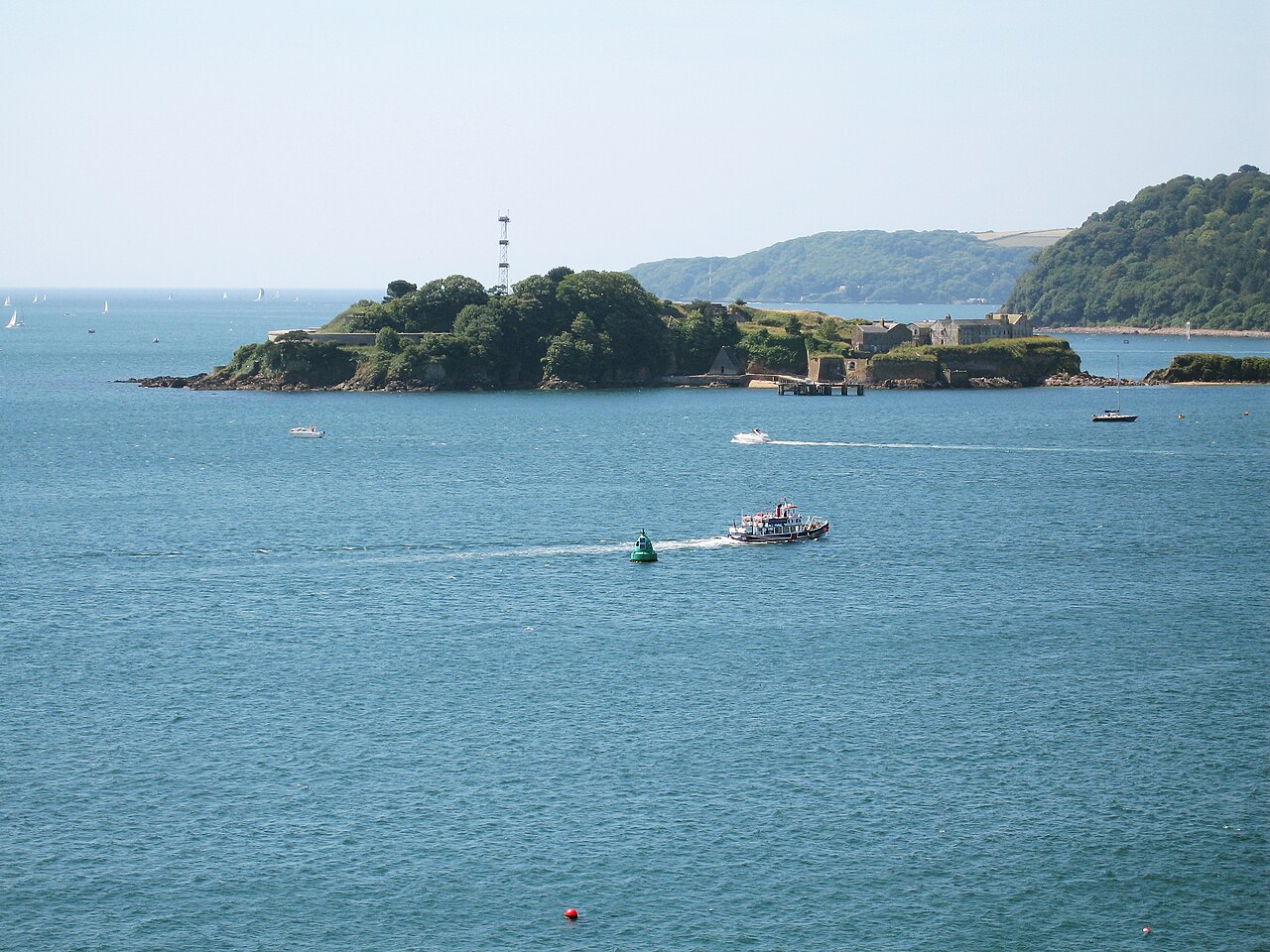
Drake's Island is a 6.5-acre (2.6-hectare) island approximately 500 metres from land in Plymouth Sound, the stretch of water south of the city of Plymouth, Devon. The rocks which make up the island are volcanic tuff and lava, together with marine limestone of the Devonian period. For more than 400 years the island was fortified.
The first recorded name for the island was in 1135, when it was referred to as St Michael's after the chapel erected on it. At some later date the chapel was rededicated to St Nicholas and the island adopted the same name. From the latter part of the 16th century the island was occasionally referred to as Drake's Island after Sir Francis Drake, the English privateer who used Plymouth as his home port. Even well into the 19th century, maps and other references continued to refer to the island as St Nicholas's Island and it is only in about the last 100 years that this name has slipped into disuse and the name Drake's Island has been adopted.
It was from Plymouth that Drake sailed in 1577, to return in 1580 having circumnavigated the world, and in 1583 Drake was made governor of the island. From 1549 the island began to be fortified as a defence against the French and Spanish, with barracks for 300 men being built on the island in the late 16th century.
In 1642, during the English Civil War, Plymouth declared itself for Parliament. During the wars, the island was used to defend Plymouth from the Royalist army's siege of the city.
For several centuries, the island remained the focal point of the defence of the three original towns that were to become modern Plymouth. In 1665 the Leveller Robert Lilburne died imprisoned on the island. He had been sentenced to life imprisonment for his part in the regicide of Charles I. A few years later John Lambert, a former general of the New Model Army in the English Civil War, was moved to Drake's Island from Guernsey, where he had been imprisoned since 1662. Like Lilburne, he never regained his liberty, dying on Drake's Island in the winter of 1683.
In June 1774 the first recorded submarine fatality in history occurred north of Drake's Island, when a carpenter named John Day perished while testing a wooden diving chamber attached to the sloop Maria.
The 1859 Royal Commission on the Defence of the United Kingdom recommended a huge programme of new fortifications to defend Plymouth.
Text adapted from “Drake's Island” on Wikipedia, CC BY-SA 4.0.
Drake's Island ranks #1,291 of 9,079 worldwide in the atlas's castle fame ranking, and #86 of the 360 mapped in England. Founded 1135, it is older than 83% of the atlas's dated landmarks — one of 756 atlas entries founded in the 12th century. Its Wikipedia articles were opened 4,757 times in the last 60 days, more than 86% of the atlas. 3 more atlas landmarks stand within 25 km. See how England compares in the castle statistics.
View on the interactive castle map →