 Lebanon · 13th century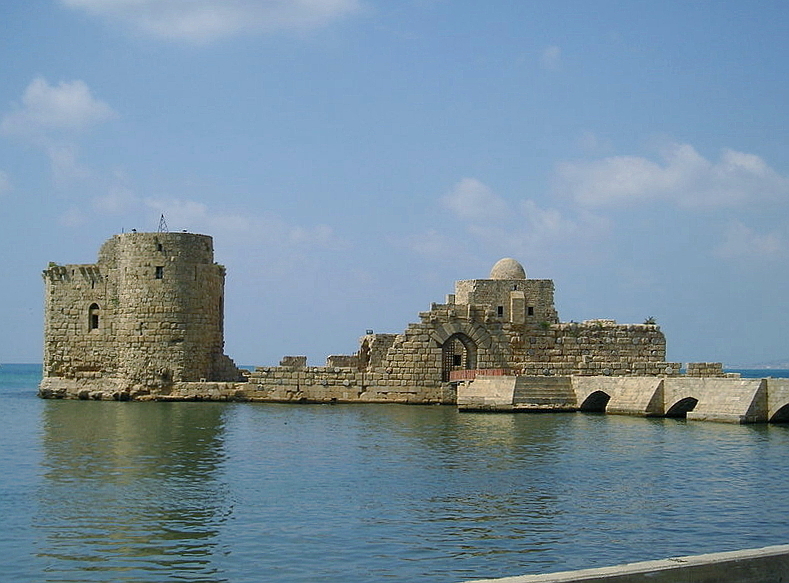
Sidon's Sea Castle (Arabic: قلعة صيدا البحرية, romanized: Kalaat Saida al-Bahriya) was built by the crusaders in the thirteenth century as a fortress of the Holy Land. It is one of the most prominent historical sites in the port city of Sidon, Lebanon.
The city of Sidon is located on the Mediterranean coast of Lebanon. This ancient Phoenician city has been of great religious, political and commercial value; it is said to be inhabited since 4000 B.C. In AD 1228, the Crusaders built Sidon's Sea Castle as a fortress on a small island connected to the mainland by a narrow 80m long roadway. The island was formerly the site of a temple to Melqart, the Phoenician version of Heracles. The beauty of the Castle can be seen in old illustrations of it; however, after bearing several wars, it has been damaged and renovated several times. It was partially destroyed by the Mamluks when they took over the city from the Crusaders, but they subsequently rebuilt it and added the long causeway. The castle later fell into disuse, but was again restored in the 17th century by Emir Fakhreddine II, only to suffer great damage.
There is a possibility that the island on which the castle is built was, in fact, the location of the Phoenician King's palace and several other Phoenician monuments which were destroyed by Esarhaddon and then by natural earthquakes. This island has also served as a shelter from inside attacks on the city. Great Sidon, Little Sidon, powerful fortresses, pastures, cisterns and fortifications are all mentioned in the Assyrian king Sennacherib's recordings of his attacks on Sidon and nearby cities.
Today, the castle consists primarily of two towers connected by a wall. In the outer walls, Roman columns were used as horizontal reinforcements, a feature often seen in fortifications built on or near former Roman sites. The rectangular west tower to the left of the entrance is the better preserved of the two. There is a large vaulted room scattered with old carved capitals and rusting cannonballs. A winding staircase leads up to the roof, where there is a small, domed Ottoman-era mosque. From the roof, there is a view across the old city and fishing harbor. The east tower is not as well preserved and was built in two phases; the lower part dates to the Crusader period, while the upper level was built by the Mamluks.
Text adapted from “Sidon Sea Castle” on Wikipedia, CC BY-SA 4.0.
Sidon Sea Castle ranks #1,474 of 9,079 worldwide in the atlas's castle fame ranking, and #3 of the 17 mapped in Lebanon. Founded 1228, it is older than 73% of the atlas's dated landmarks — one of 1080 atlas entries founded in the 13th century. Its Wikipedia articles were opened 2,381 times in the last 60 days, more than 73% of the atlas. 5 more atlas landmarks stand within 25 km. The nearest day-trip guide is Sidon, 1 km away. It is one of the 106 landmarks on the atlas's regional map of the Levant. It is stop 4 of 7 on the Crusader castles of the Levant, the Syrian coast to southern Jordan. See how Lebanon compares in the castle statistics.
View on the interactive castle map →