 England · 11th century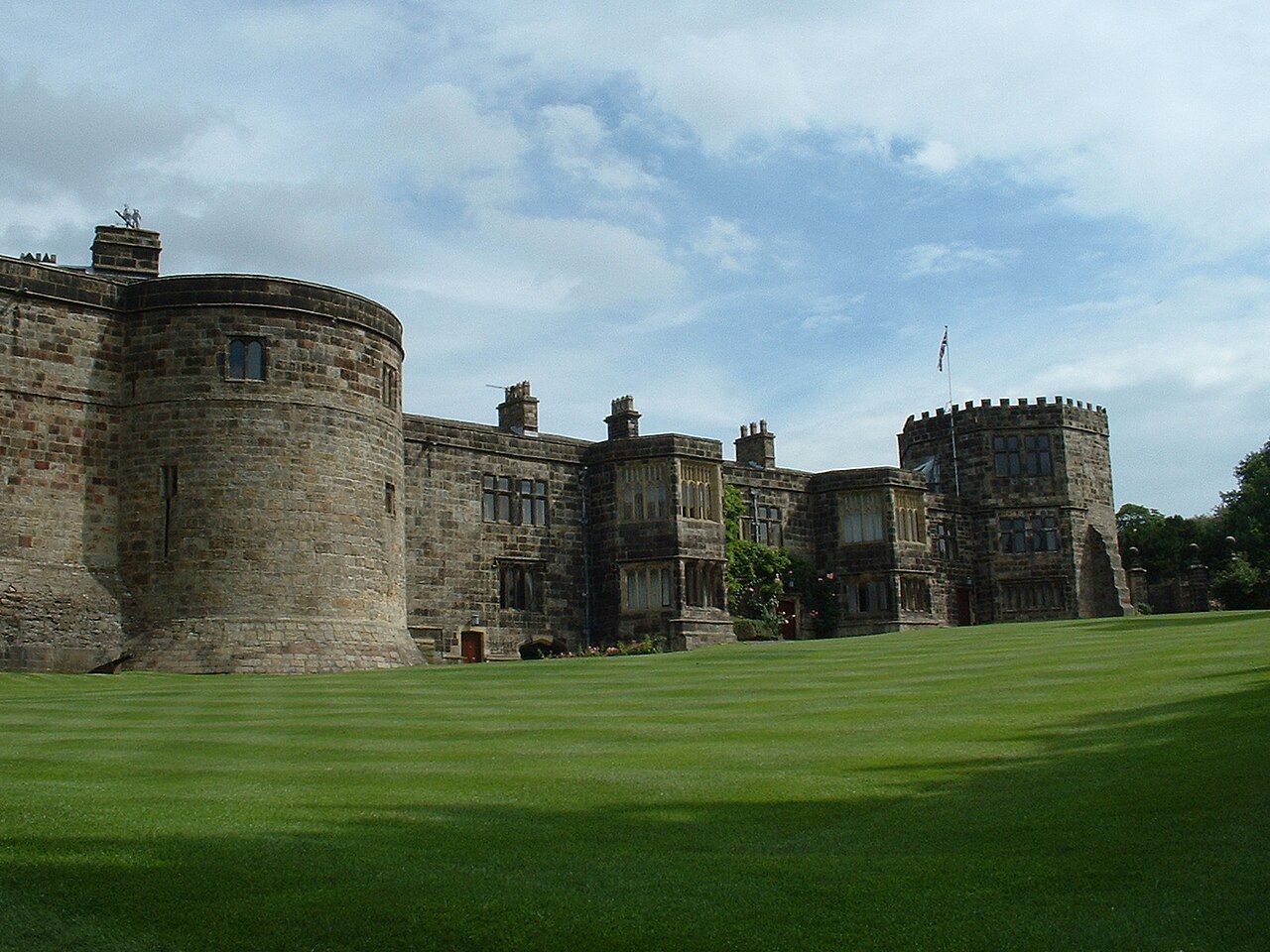
Skipton Castle is a well-preserved Grade I Listed medieval castle in Skipton, North Yorkshire, England. It was built in 1090 by Robert de Romille, a Norman baron and is now a tourist attraction and private residence. It is located at the north end of Skipton's High Street.
Skipton Castle was originally a motte and bailey castle built in 1090 by Robert de Romille, lord of the multiple estates of Bolton Abbey. Shortly after 1102, Henry I extended Romille's lands to include all of upper Wharfedale and upper Airedale. The earth and wood castle was rebuilt in stone to withstand attacks by the Scots. Dropping down to Eller Beck, the cliffs behind the castle made it a perfect defensive structure. In 1310, after the Romille line had died out, Edward II granted the castle to Robert Clifford who was appointed Lord Clifford of Skipton and Guardian of Craven. Lord Clifford ordered many improvements to the fortifications, but he died in the Battle of Bannockburn in 1314 when the improvements were barely complete. Skipton was raided by the Scots during the Great Raid of 1322, yet the castle, with all its improvements, withstood the attack.
During the English Civil War, the castle was the last Royalist stronghold in the north of England to surrender, in December 1645. After a three-year siege, a surrender was negotiated on 21 December 1645 between Oliver Cromwell and the Royalists. Cromwell slighted the castle by ordering the removal of the roofs. Legend has it that during the siege, sheep fleeces were hung over the walls to deaden the impact from the rounds of cannon fire. Sheep fleeces feature in the town's coat of arms. Skipton remained the Cliffords' principal seat until 1676. Lady Anne Clifford (1590–1676) was the last Clifford to own the castle.
After the siege, she ordered repairs and planted a yew tree in the central courtyard to commemorate its restoration after the war. Lady Anne's daughter, Lady Margaret Sackville (1614–1676), married John Tufton, 2nd Earl of Thanet (1609–1664), and the castle was then passed down through the Tufton family, becoming the seat of Lord Hothfield in 1871.
Reginaldus Flandrensis, who held an office of trust as Seneschal of Skipton Castle, witnessed a Skipton charter around 1130. "We must assume that these lands were given to him at about that time as a reward for his services.
Text adapted from “Skipton Castle” on Wikipedia, CC BY-SA 4.0.
Skipton Castle ranks #1,448 of 9,079 worldwide in the atlas's castle fame ranking, and #94 of the 360 mapped in England. Founded 1090, it is older than 87% of the atlas's dated landmarks — one of 436 atlas entries founded in the 11th century. Its Wikipedia articles were opened 3,700 times in the last 60 days, more than 82% of the atlas. The nearest day-trip guide is Manchester, 57 km away. See how England compares in the castle statistics.
View on the interactive castle map →