 Israel · 12th century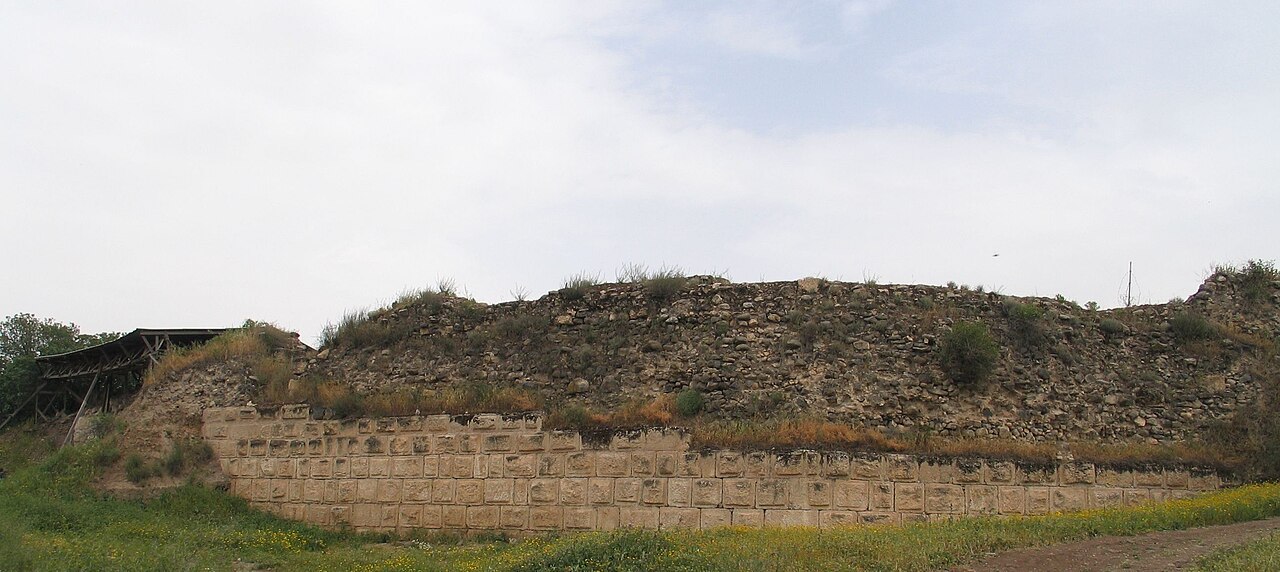
Chastelet also known as Beytulahzan was a castle located beside Jacob's Ford, a ford of the upper Jordan River in Israel. The castle was built during the Crusades by the Knights Templar and the forces of the Kingdom of Jerusalem but was destroyed by the army of Saladin in 1179.
The name of the castle comes from the French word châtelet, meaning a fortified gatehouse. Jacob's Ford is also known by the Latin name of Vadum Iacob and in modern Hebrew as Ateret.
The castle was intended to act as a bulwark against Muslim incursions into the Kingdom of Jerusalem and to strength protection for pilgrims and traders through Christian Palestine. Jointly constructed by the Knights Templar and the Kingdom of Jerusalem under orders of Baldwin IV of Jerusalem, construction of the castle began in 1178.
By May 1179, the main walls (built of lime, stone and pebbles) and foundations were completed, which included a perimeter wall with five gates, and a tower. The castle was fit for purpose and well-supplied, but not structurally complete. Some 1,500 men camped around the complex. Most of them were knights and sergeants of the military garrison, with several hundred workmen: blacksmiths, builders and Muslim prisoners used as laborers. After hearing of the castle's completion, Saladin brought his army within attacking distance of the castle and offered 60,000 dinars for a peaceful demolition of it. After his offer was rejected, he decided to test its defenses by moving his army to the walls and harassing the defenders with arrows.
After one of his commanders was shot by a Templar arrow, Saladin retreated. King Baldwin IV's council sent an army to reinforce the castle, and on the way, they met and defeated a group of Saladin's men on a raiding expedition. The king's cavalry pursued the survivors and ran into Saladin and his main host. In the ensuing battle Saladin defeated the king's army and captured around 270 Christian horsemen, among them Templar master Odo of Saint-Armand. King Baldwin IV managed to escape.
On 24 August 1179, Saladin laid siege to the fortress. His most trusted officers advised a quick attack instead of a regular siege, and the Muslims subsequently barraged the outer defences. When Baldwin IV heard of this, he summoned a host to Tiberias to respond.
Text adapted from “Chastelet” on Wikipedia, CC BY-SA 4.0.
Ateret Fortress ranks #2,098 of 9,079 worldwide in the atlas's castle fame ranking, and #9 of the 23 mapped in Israel. Founded 1178, it is older than 78% of the atlas's dated landmarks — one of 756 atlas entries founded in the 12th century. Its Wikipedia articles were opened 2,756 times in the last 60 days, more than 76% of the atlas. 3 more atlas landmarks stand within 25 km. The nearest day-trip guide is Nawa, 42 km away. It is one of the 106 landmarks on the atlas's regional map of the Levant. See how Israel compares in the castle statistics.
View on the interactive castle map →