 Wales · 13th century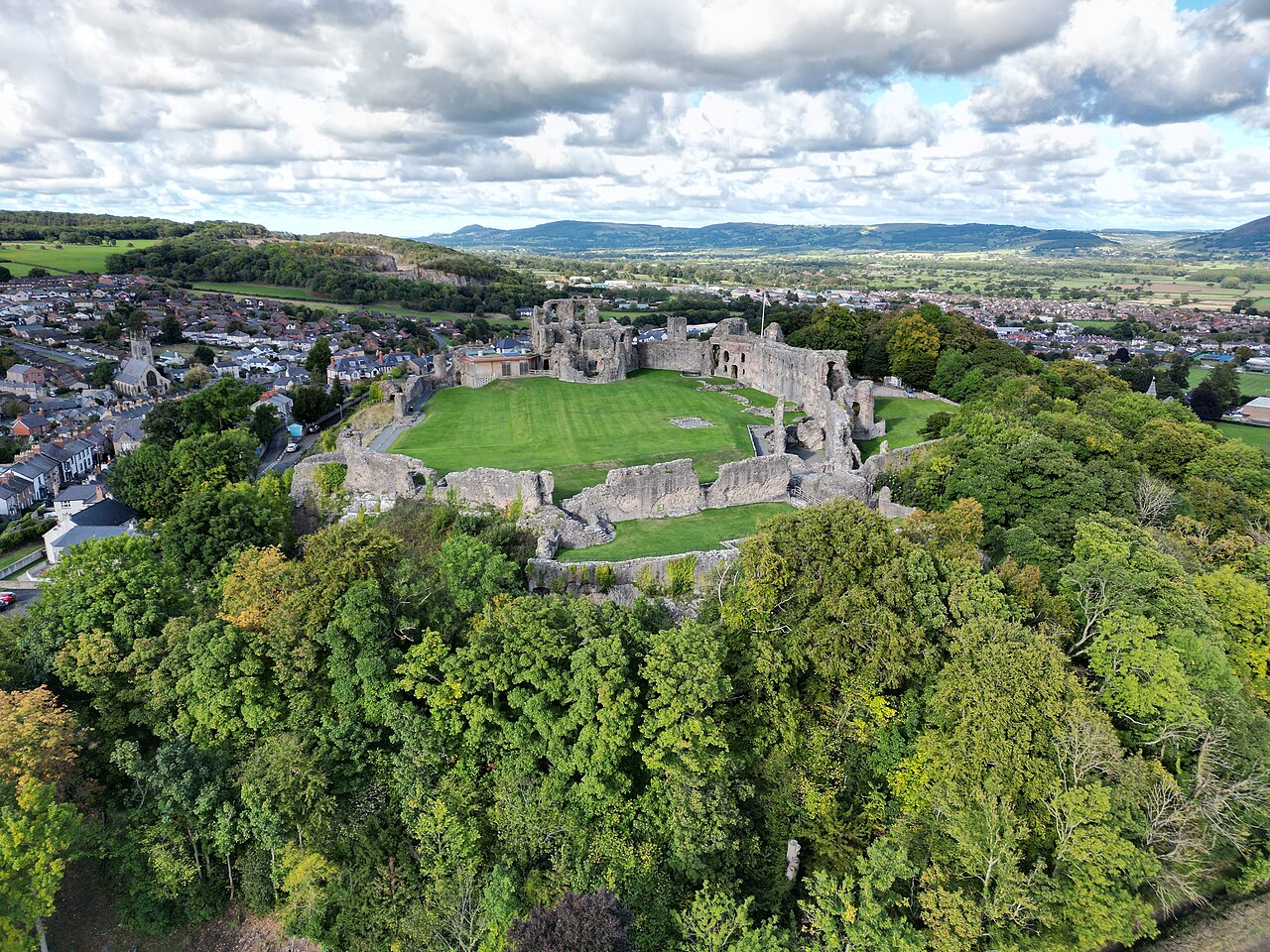
Denbigh Castle and town walls ( DEN-bee; Welsh: Castell Dinbych a waliau tref [ˌkastɛɬ ˈdɪnbɨχ]) were built to control the lordship of Denbigh after the Conquest of Wales by Edward I of England in 1282. The lands were granted to Henry de Lacy, Earl of Lincoln, who began to build a new walled town, colonised by immigrants from England, protected by a substantial castle and surrounded by deer parks for hunting. The work had not been completed by 1294, when the Welsh temporarily seized the castle during the Madog ap Llywelyn revolt. The defences continued to be improved, although the castle was not completely finished by the time of Henry's death in 1311.
The castle passed between various owners in the first half of the 14th century, before coming under the control of the Mortimer family. Meanwhile, the walled town had proved impractical to live in, and a newer, much larger, settlement developed outside the defences. In 1400, the walled town was raided during the Glyndŵr Rising, although the castle itself remained secure throughout the rebellion. During the Wars of the Roses, Denbigh was attacked by Lancastrian forces; the walled town was attacked and burnt. In the aftermath, the old town was largely abandoned by its inhabitants, the walled area becoming an extension of the castle's defences.
During the First English Civil War, Denbigh was held by the Royalists until it was captured by Parliamentarian forces in October 1646. The castle was seized by pro-Royalist soldiers in 1659, after which General George Monk ordered it to be slighted, with various parts of the walls and towers being demolished. The site deteriorated further over the years and the old walled town remained almost deserted. In the middle of the 19th century, the town created a committee to manage the ruins and carried out restoration work.
Text adapted from “Denbigh Castle and town walls” on Wikipedia, CC BY-SA 4.0.
Denbigh Castle ranks #2,412 of 9,079 worldwide in the atlas's castle fame ranking, and #37 of the 107 mapped in Wales. Founded 1282, it is older than 64% of the atlas's dated landmarks — one of 1080 atlas entries founded in the 13th century. Its Wikipedia articles were opened 1,153 times in the last 60 days, more than 54% of the atlas. 7 more atlas landmarks stand within 25 km. The nearest day-trip guide is Wrexham, 32 km away. It is one of the 27 landmarks on the atlas's regional map of North Wales. It is stop 3 of 8 on Edward I’s ring of iron, Flint to Beaumaris. See how Wales compares in the castle statistics.
View on the interactive castle map →