 England · 14th century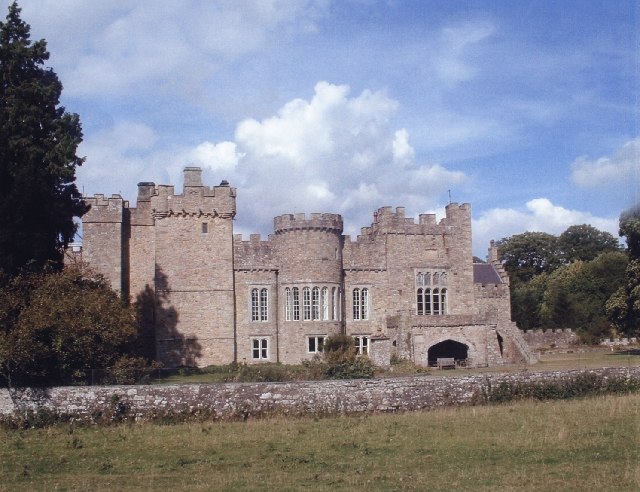
Featherstone Castle, a Grade I listed building, is a large Gothic style country mansion situated on the bank of the River South Tyne about 3 miles (5 km) southwest of the town of Haltwhistle in Northumberland, England.
In the 11th century the manor house on this site belonged to the Featherstonehaugh family. It has played an important role in the battles between the English and the Scots. The building was possibly a 13th-century hall house, and a square three-storey pele tower was added in 1330 by Thomas de Featherstonehaugh. A survey from the year 1541 reported the property to be a tower in good repair, occupied by Thomas Featherstonehaugh.
The earliest recorded history of this area derives from the Roman occupation period; in 122 AD, the Romans erected Hadrian's Wall, the course of which lies about 5 kilometres to the north of Featherstone Castle.
In the 17th century the property was acquired by Sir William Howard (father of the 1st Earl of Carlisle) and was remodelled and substantially enlarged.
The house was repurchased from the Earl of Carlisle in 1711 by Matthew Featherstonehaugh (1662–1762). A survey of 1715 disclosed 'an ancient and well-built structure'. The family remained in occupation until Sir Matthew Fetherstonhaugh sold the property to James Wallace about 1789. His son Thomas Wallace carried out further alterations between 1812 and 1830. Lord Wallace bequeathed the estate to his nephew Colonel James Hope (1807–1854), (son of the Earl of Hopetoun), who changed his name to Hope-Wallace.
The various alterations to the structure have resulted in a large castellated and complex country house, rectangular in form with a central courtyard and towers at each angle.
In 1825, farmers working on the lands at Wydon Eals near Featherstone Castle discovered what was thought at first to be a buried oak tree trunk. However, when they proceeded to cut it with an axe, it was revealed to be an oaken coffin containing human remains. These bones steadily turned into dust when they were exposed to the atmosphere. The remains of four other wooden coffins were discovered in the same area. These log-coffins have been stated to belong to the early medieval period, and similar examples have been found in the north and east of England.
Text adapted from “Featherstone Castle” on Wikipedia, CC BY-SA 4.0.
Featherstone Castle ranks #2,107 of 9,079 worldwide in the atlas's castle fame ranking, and #141 of the 360 mapped in England. Founded 1330, it is older than 59% of the atlas's dated landmarks — one of 755 atlas entries founded in the 14th century. Its Wikipedia articles were opened 2,709 times in the last 60 days, more than 76% of the atlas. 15 more atlas landmarks stand within 25 km. The nearest day-trip guide is Newcastle upon Tyne, 57 km away. See how England compares in the castle statistics.
View on the interactive castle map →