 Wales · 1st century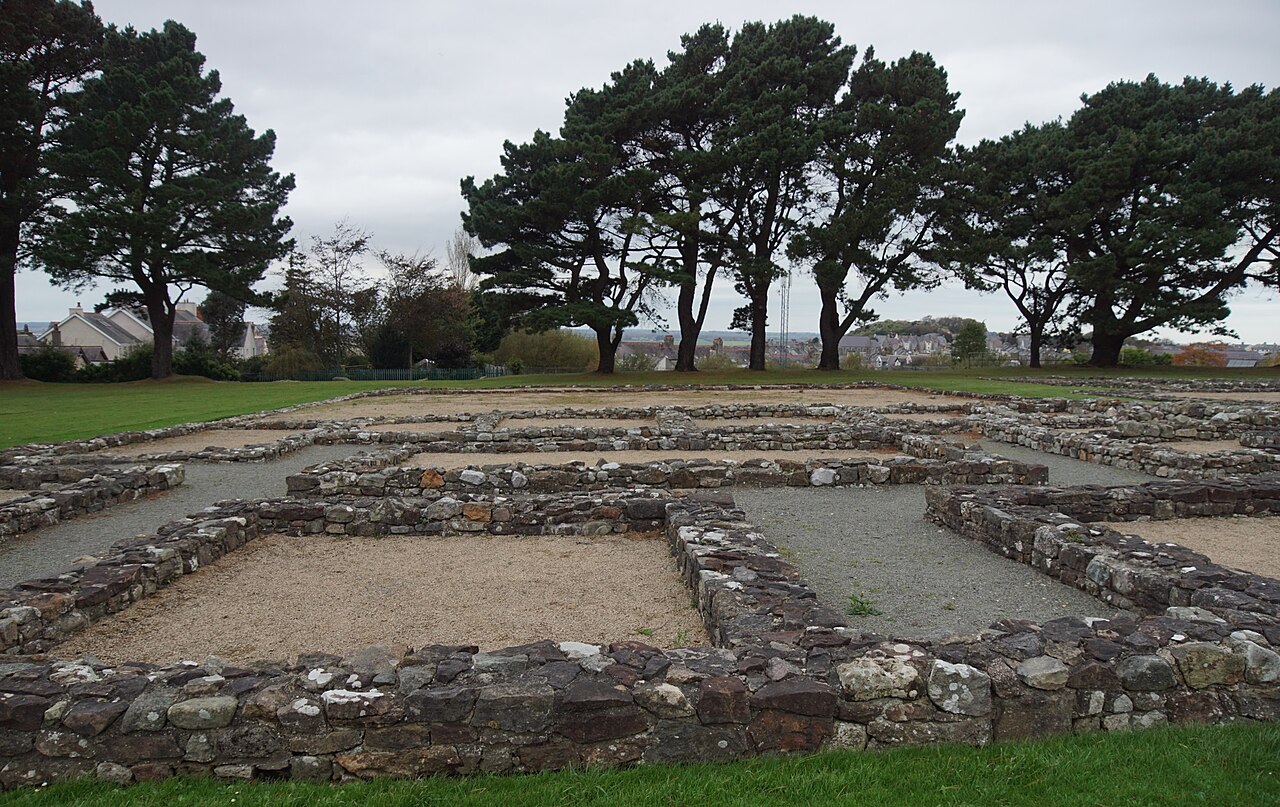
Segontium (Old Welsh: Cair Segeint) is a Roman fort on the outskirts of Caernarfon in Gwynedd, North Wales.
The fort probably takes its name either directly from the Afon Seiont or from a pre-existing British settlement itself named for the river. The name is a Latinised form of the Brythonic language *seg-ontio, which may be translated as "strong place".
There is no evidence that the fort is connected to the Segontiaci, a British tribe noted by Julius Caesar.
Segontium was founded by Agricola in AD 77 or 78 after he had conquered the Ordovices in North Wales. It was the main Roman fort in the north of Roman Wales and was designed to hold about a thousand auxiliary infantry. It was connected by a Roman road to the Roman legionary base at Chester, Deva Victrix. Unlike the medieval Caernarfon Castle that was built alongside the Seiont estuary more than a thousand years later, Segontium was situated on higher ground to the east giving a good view of the Menai Strait.
The original timber defences were rebuilt in stone in the first half of the 2nd century. In the same period, a large courtyard house (with its own small bathhouse) was built within the fort. The high-status building may have been the residence of an important official who was possibly in charge of regional mineral extraction. Archaeological research shows that, by the year 120, there had been a reduction in the military numbers at the fort. An inscription on an aqueduct from the time of the Emperor Septimius Severus indicates that, by the 3rd century, Segontium was garrisoned by 500 men from the Cohors I Sunicorum, which would have originally been levied among the Sunici of Gallia Belgica. The size of the fort continued to reduce through the 3rd and 4th centuries.
At this time Segontium's main role was the defence of the north Wales coast against Irish raiders and pirates. Coins found at Segontium show the fort was still occupied until at least 394.
Segontium is generally considered to have been listed among the 28 cities of Britain listed in the History of the Britons traditionally ascribed to Nennius, either as Cair Segeint or Cair Custoeint. Bishop Ussher cites another passage in Nennius: "Here, says Nennius, Constantius the Emperor (the father probably of Constantine the Great) died; that is, near the town of Cair Segeint, or Custoient, in Carnarvonshire".
Text adapted from “Segontium” on Wikipedia, CC BY-SA 4.0.
Castrum Segontium ranks #1,948 of 9,079 worldwide in the atlas's castle fame ranking, and #29 of the 107 mapped in Wales. Founded 77, it is older than 98% of the atlas's dated landmarks — one of 33 atlas entries founded in the 1st century. Its Wikipedia articles were opened 1,987 times in the last 60 days, more than 69% of the atlas. 7 more atlas landmarks stand within 25 km. The nearest day-trip guide is Wrexham, 86 km away. It is one of the 27 landmarks on the atlas's regional map of North Wales. See how Wales compares in the castle statistics.
View on the interactive castle map →