 South Korea · 14th century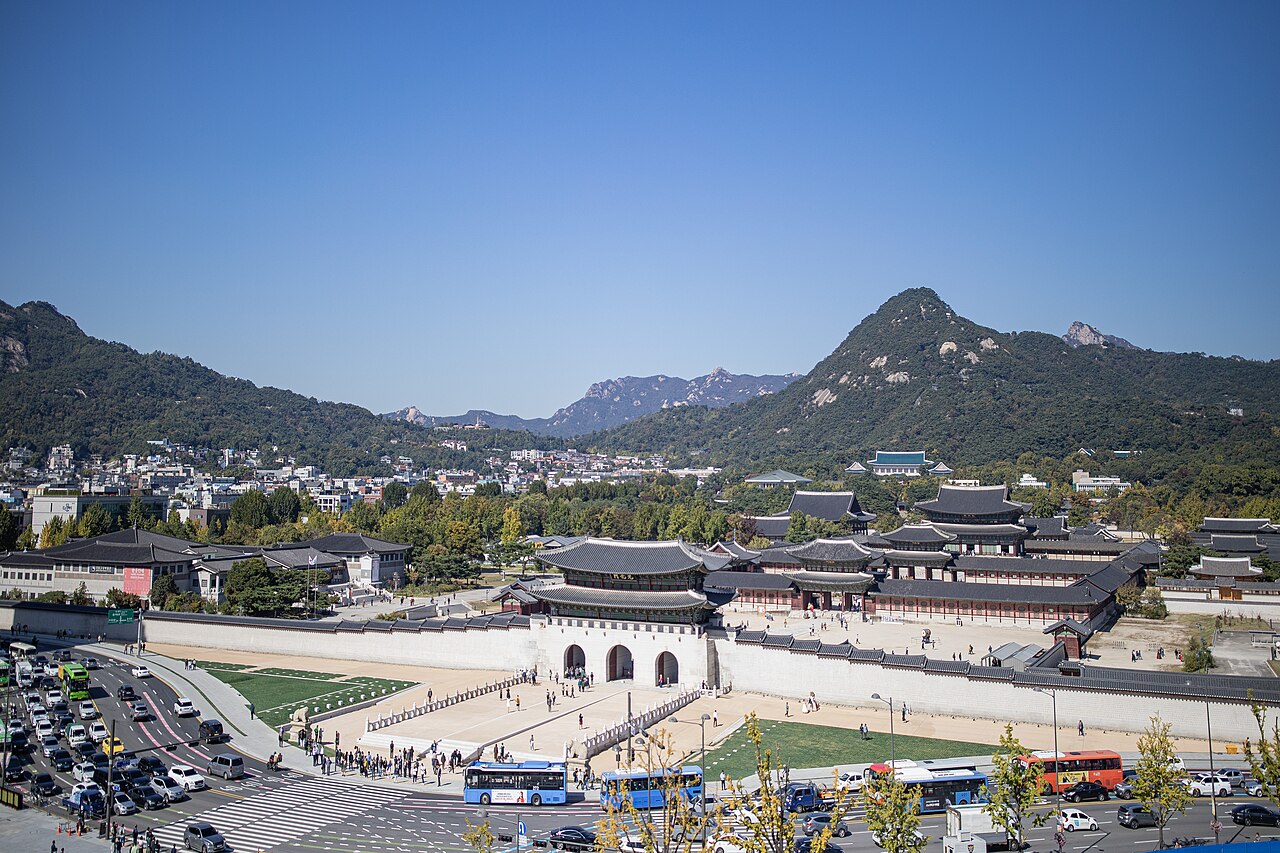
Gyeongbokgung (Korean: 경복궁; Hanja: 景福宮; pronounced [kjʌŋbok̚k͈uŋ]) is a former royal palace in Seoul, South Korea. Established in 1395, it was the first royal palace of the Joseon dynasty, and is now one of the most significant tourist attractions in the country.
The palace was among the first landmarks to be established in Seoul. It flourished under the 1418–1450 reign of Sejong the Great; Sejong led the creation of the native Korean script Hangul at the palace. In 1592, amidst the Imjin War, the palace was completely burned down. Plans to repair the palace fell through amidst funding shortages after the war. It would not be restored until the late 19th century, during the reign of the penultimate monarch Gojong.
In 1910, Japan colonized Korea. As the palace was a symbol of the Korean monarchy's authority, Japan systematically demolished and altered it. Almost all of its around 500 structures were sold off and shipped elsewhere; by the 1945 liberation of Korea, only 40 pre-colonial buildings remained. In their place, modern-style colonial buildings like the Government-General of Chōsen Building were established.
After decades of political turmoil and poor economic conditions, significant efforts to restore the palace to its pre-colonial state began in the 1980s. Since then, the 1990–2010 First Gyeongbokgung Restoration Plan and 2008–2045 Second Gyeongbokgung Restoration Plan have resulted in the recreations of dozens of buildings in the palace, with dozens more scheduled for the future.
The palace hosts a changing of the guard ceremony twice per day. It contains the National Folk Museum of Korea and the National Palace Museum of Korea. Gyeongbokgung is accessible by the subway station Gyeongbokgung Station. For part of the year, it is open at night. Entrance is free for visitors wearing hanbok (traditional Korean clothing).
Text adapted from “Gyeongbokgung” on Wikipedia, CC BY-SA 4.0.
Gyeongbokgung ranks #62 of 9,079 worldwide in the atlas's castle fame ranking, and #1 of the 57 mapped in South Korea. Founded 1395, it is older than 52% of the atlas's dated landmarks — one of 755 atlas entries founded in the 14th century. Its Wikipedia articles were opened 64,653 times in the last 60 days, more than 99% of the atlas. 14 more atlas landmarks stand within 25 km. The nearest day-trip guide is Seoul, 2 km away. See how South Korea compares in the castle statistics.
View on the interactive castle map →