 England · 16th century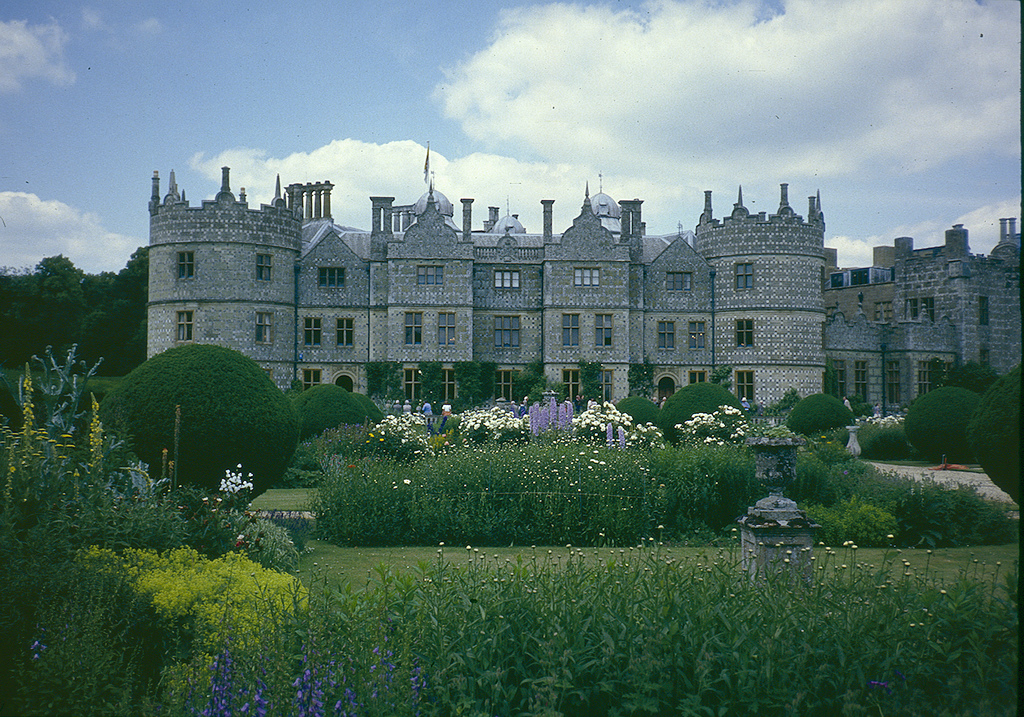
Longford Castle is a Grade I listed country house on the banks of the River Avon south of Salisbury, Wiltshire, England. It is the seat of the Earl of Radnor and an example of the Elizabethan prodigy house.
In 1573 Thomas Gorges acquired the manor (at the time written "Langford"), which was originally owned by the Servington (or Cervington) family. Prior to this the existing mansion house had been damaged by fire. In c.1576 Thomas Gorges married Helena Snakenborg, the Swedish-born dowager Marchioness of Northampton and Lady-in-waiting to Queen Elizabeth. They rebuilt the Longford property as a triangular Swedish pattern castle on the banks of the River Avon. The building work became costly due to difficulties with the subsoil.
Sir Thomas Gorges, who was now governor of Hurst Castle, Hampshire, persuaded his wife to beg of the Queen a shipwreck he knew from the defeated Spanish Armada. The gift was granted and the gold and silver retrieved from the shipwreck funded the completion of the castle under the final supervision of John Thorpe in 1591. The family lived in the castle for several years before its final completion.
In September 1603 the royal family came on progress nearby and Roger Wilbraham described Longford as "a faire new house of stone, a triangle with three great towers at each end, wherein are his favourite chambers, & he hath the fairest garden and green walks". The main building had several floors and was triangular with a round tower at each corner; the three towers representing the Father, the Son and the Holy Ghost. There was a chapel, kitchen department, several boudoirs and sitting rooms, as well as bedrooms. Fresh cold water was pumped to various floors and there were water closets supplied with rainwater. A park, fruit garden and kitchen garden were attached.
In 1717 Longford Castle became the Bouverie home, purchased by Sir Edward des Bouverie from the Coleraines. It is said that Sir Edward saw and fell in love with the castle in the valley as he rode past, having enough money in his saddle bags to effect the purchase there and then. Subsequent generations of the family beautified the interior of the castle and surrounding park; by 1773 the castle was surrounded by a formal park, laid out with avenues and rides. Landscaping advice was sought from Capability Brown around 1777.
Text adapted from “Longford Castle” on Wikipedia, CC BY-SA 4.0.
Longford Castle ranks #1,937 of 9,035 worldwide in the atlas's castle fame ranking, and #129 of the 360 mapped in England. Founded 1591, it is older than 32% of the atlas's dated landmarks, one of 886 atlas entries founded in the 16th century. Its Wikipedia articles were opened 4,795 times in the last 60 days, more than 86% of the atlas. 4 more atlas landmarks stand within 25 km. The nearest day-trip guide is Southampton, 29 km away. See how England compares in the castle statistics.
View on the interactive castle map →