 India · 18th century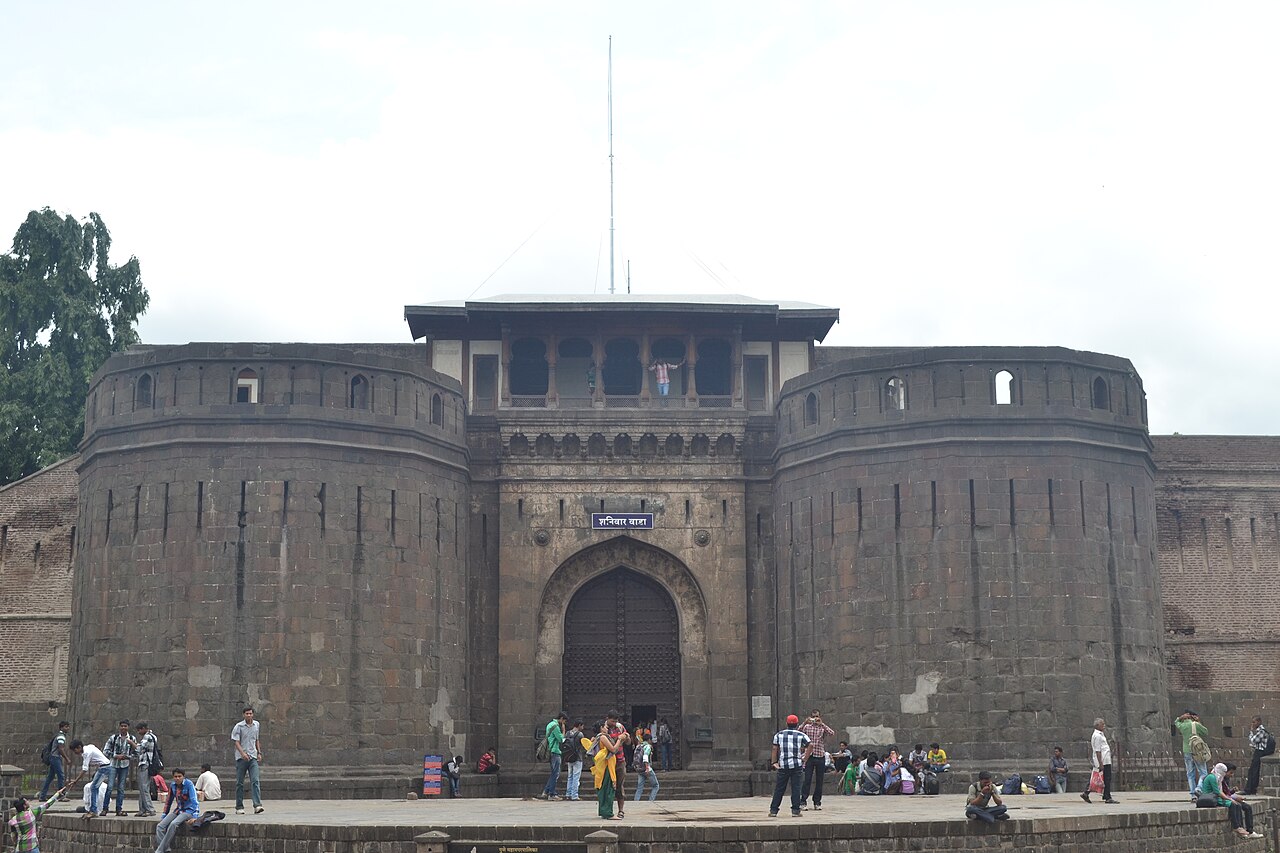
Shaniwar Wada is a historical fortification in the city of Pune, India. Built in 1732, it was the seat of the Peshwas of the Maratha Confederacy until 1818. The fort itself was largely destroyed in 1828 by an unexplained fire, but the surviving structures are now maintained as a tourist site.
The Shaniwar Wada was normally the seven-story capital building of the Peshwas of the Maratha Empire. It was supposed to be made entirely of stone. However, after the completion of the base floor or the first story, the people of Satara (the national capital) complained to the Chhatrapati Shahu saying that a stone monument can be sanctioned and built only by the Chhatrapati himself and not the Peshwas. Following this, an official letter was written to the Peshwas stating that the remaining building had to be made of brick and not stone.
By 1758, at least a thousand people lived in the fort. In 1773, Narayanrao, who was the tenth and ruling Peshwa then, was murdered by guards on orders of his uncle Raghunathrao and aunt Anandibai. A popular legend has it that Narayanrao's ghost still calls for help on full moon nights. Various people, working around the area, have allegedly reported the cries of "Kaka mala vachava" (Uncle, save me) by Narayanrao Peshwa after his death. The book, Assassination of the Peshwa, written in English and Marathi, covers this incident in detail.
In June 1818, the Peshwa, Bajirao II, abdicated his Gaadi (throne) to Sir John Malcolm of the British East India Company and went into political exile at Bithoor, near Kanpur in present-day Uttar Pradesh, India. On 27 February 1828, a great fire started inside the palace complex. The conflagration raged for seven days. Only the heavy granite ramparts, strong teak gateways and deep foundations and ruins of the buildings within the fort survived.
According to Haricharitramrutsagar, a biographical text of Bhagwan Swaminarayan, he had visited Shaniwarwada on the insistence of Bajirao II in 1799.
Peshwa Baji Rao I, prime minister to Chattrapati Shahu, laid the ceremonial foundation of his own residence on Saturday, 10 January 1730. It was named Shaniwar Wada from the Marathi words Shaniwar (Saturday) and Wada (a general term for any residence complex).
Text adapted from “Shaniwar Wada” on Wikipedia, CC BY-SA 4.0.
Shaniwar Wada ranks #644 of 9,035 worldwide in the atlas's castle fame ranking, and #26 of the 223 mapped in India. Founded 1732, it is older than 19% of the atlas's dated landmarks, one of 685 atlas entries founded in the 18th century. Its Wikipedia articles were opened 14,126 times in the last 60 days, more than 96% of the atlas. 2 more atlas landmarks stand within 25 km. The nearest day-trip guide is Pune, 1 km away. See how India compares in the castle statistics.
View on the interactive castle map →